
Prediction Market Trading
Inefficiency in Prediction Markets and Modeling Prediction Markets as Options

Hello,
Welcome back to another paid-subscriber only post. Today, we will be discussing how prediction markets can be modeled as exotic options, and how we can systematically exploit the structural inefficiencies within them.
Let’s get into it.
Modeling Prediction Markets as Exotic Options
Prediction markets are often misunderstood by retail traders as simple sports-betting parlors for geopolitical or macroeconomic events. However, from a structural standpoint, they are sophisticated derivatives exchanges trading exotic options. By mapping these prediction contracts to their traditional options counterparts, we can better understand their pricing dynamics and the mathematical edge required to trade them systematically.
Digital Option
A digital option, also known as a binary or cash-or-nothing option, provides a fixed payout if the underlying asset is trading above (for a call) or below (for a put) the strike price precisely at expiration. It is a European-style option with a strictly binary outcome: $1 or $0.
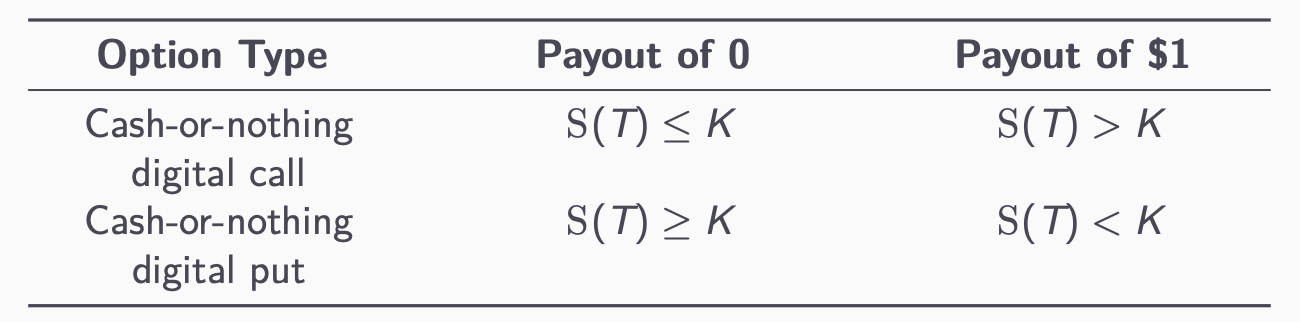
In standard Black-Scholes framework, the price of a digital call option is the discounted risk-neutral probability that the option will expire in-the-money. Mathematically, this is represented by:
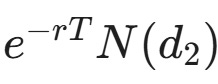
While platforms like Kalshi do provide interest on open positions, the time-value discount factor (e^(-rT) in short-duration prediction markets is negligible. As it approaches 1, the price of a near-term contract simplifies directly to N(d2), which is the market-implied probability of the event occurring.
Below, I have an example of a market on Polymarket that can be described with digital options. Note: Please click “View Polymarket” to get the updated market. The values may be stale and the layout below may not be in the correct order for S&P 500 price.
Each line item represents a distinct digital call option. If you buy "Yes" for the ">$6,860" strike at 57 cents, you are paying a $0.57 premium for a digital call that pays $1.00 if the SPX prints above $6,860 at the exact moment of expiry. The 57-cent price directly reflects a 57% market-implied probability. Because the payout is entirely binary at expiration, the Gamma of this position will become incredibly explosive as the February deadline approaches, creating massive price swings on small underlying index movements.
Digital Range (Corridor) Option
A digital range, or corridor option, pays a fixed cash amount only if the underlying asset's price settles within a specifically defined lower and upper boundary at expiration. Structurally, you can create a range option by executing a spread: going long a digital call at the lower boundary (K1) and short a digital call at the upper boundary (K2).
The value of a corridor option is the probability that the final fixing price ($S_T$) lands between the two strikes:
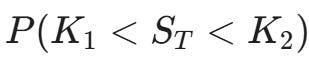
In pricing terms, it is simply the price of the lower-strike digital call minus the price of the upper-strike digital call:

The market for US strikes in Somalia is structured as a series of mutually exclusive corridor options. When you purchase the "14-17" bracket for 60 cents, you need the final count to fall strictly within that corridor. If the final number is 13 or 18, the “14-17” option expires completely worthless. The pricing here functions as a probability density function across the different brackets, with the market currently pricing a 60% probability that the final settlement falls within the 14-17 boundaries.
One Touch Option
A one-touch option is a path-dependent barrier option. Unlike standard digitals that only examine the underlying price at the moment of expiration, a one-touch option pays out if the underlying asset breaches a predefined barrier price at any single point during the life of the contract.
Pricing a one-touch option is significantly more complex than a standard digital because it accounts for the entire path of the asset. It relies heavily on the volatility of the underlying and time to expiration. Because the asset only needs to touch the barrier once, the probability of a one-touch option paying out is always strictly greater than or equal to a standard digital option at the same strike.
A One-Touch Call Option at the same strike as a Digital Call Option should be roughly 2x the value of the Digital Call Option (however, this is actually incorrect, as the "one touch = 2x digital at the same strike" only holds in a very special case (driftless Brownian motion via the reflection principle), while for a real asset price, even in plain Black Scholes, log spot has nonzero risk-neutral drift, which breaks the symmetry that gives the factor of 2, so the touch probability is not generally 2x, it’s a different expression that depends on drift (and in practice on skew/local vol/stoch vol, etc)).
The Silver by end of June market perfectly illustrates this. Notice the specific wording: "Will Silver hit..." rather than "Will Silver close above...". If you buy the "$120" strike for 29 cents, it does not matter where Silver trades on June 30th. If a volatility spike causes Silver to touch $120 in mid-April before crashing back down to $30, the barrier is breached, the option is immediately triggered, and the $1.00 payout is locked in. You are buying an American-style barrier payout, making Vega (sensitivity to implied volatility) a massive driver of this contract's pricing.
That was a lot, and I could discuss this with much more depth if it is of interest.
Below, I will introduce a trading strategy that I have been working on over the last two weeks. The strategy looks quite promising, and I will launch the systematic trading strategy live on Kalshi in the next few days.